


Views: 0 Author: Site Editor Publish Time: 2026-08-14 Origin: Site


For wheelchair users, chamber size alone does not determine accessibility. A model can look spacious yet still be difficult to use if the entrance is too narrow, the threshold interferes with front casters, or the interior cannot accommodate the chair in its normal position. Entry design, usable interior space, positioning, and setup requirements all affect whether a chamber is genuinely practical.
Before choosing a Hyperbaric Oxygen Chamber for home use, buyers should compare the wheelchair, chamber opening, room layout, controls, and oxygen system as one complete fit rather than isolated specifications.
“Wheelchair accessible” should answer a very specific question: Can the user stay in the wheelchair while entering the chamber? In a direct roll-in design, the wheelchair moves through the entrance and remains the user's seat during the session. A transfer-entry design works differently—the chair stops outside, and the user moves onto an internal seat, cushion, or platform.
That difference may be minor for someone who transfers independently, but it becomes critical when standing, pivoting, balance, or lower-body strength is limited. A transfer may also require caregiver assistance every time the Hyperbaric Oxygen Chamber is used, adding another physical step before and after each session. Buyers should therefore avoid treating “sitting,” “vertical,” and “wheelchair accessible” as interchangeable descriptions.
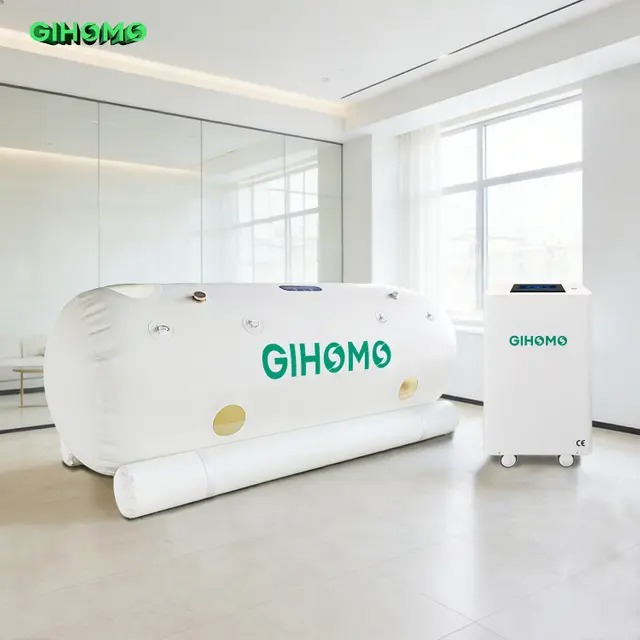
Gihomo’s SC001 uses a barrier-free entrance designed to let users remain in their own wheelchair rather than moving to an internal seat. This kind of configuration addresses accessibility at the entry point instead of simply providing a larger chamber or an upright seating position. For buyers who cannot transfer safely or independently, that distinction should be established before comparing other specifications.
Overall chamber dimensions tell you how much room the equipment occupies, but they do not reveal whether a wheelchair can pass through the entrance. The more useful figures are the clear usable opening width and height after the chamber is fully set up. Inflatable borders, zipper tracks, frames, seals, or structural supports can make the functional opening smaller than the chamber's external width suggests.
Measure the wheelchair at its widest actual point, which may be the rear wheels, hand rims, armrests, joystick, or another attachment. Then compare that number with the usable opening rather than aiming for an exact match. Some extra clearance makes alignment easier and reduces the chance of wheels or accessories contacting the chamber during entry.
Width alone does not determine whether an entrance works. Front casters and footplates still have to cross the threshold, so buyers should check the height of any raised edge and, where a ramp is provided, its usable width, slope, surface grip, and transition into the chamber. A steep or abrupt transition can turn an otherwise wide doorway into an awkward obstacle.
The approach area outside the chamber matters just as much. A wheelchair needs enough room to line up with the entrance, enter in a controlled path, and reverse or maneuver during exit. For a power wheelchair in particular, consider turning radius and footplate projection before deciding that the available floor space is adequate.
Wheelchair seat width is not enough for chamber sizing. Instead, measure the chair in its normal working configuration with the user and essential accessories in mind. Include the maximum width across the wheels or armrests, the complete length with footrests, seated height to the top of the head, and the height of headrests, push handles, or positioning equipment.
These measurements should represent real use rather than the smallest dimensions in the wheelchair specifications. Removable accessories that are normally needed should remain part of the fit calculation, because taking them off for every session may defeat the purpose of convenient accessibility. The same principle applies to bags, lateral supports, joystick assemblies, and other components that change the overall envelope of the chair.
Avoid choosing a Hyperbaric Oxygen Chamber whose dimensions barely exceed those measurements. A mathematical fit may still be uncomfortable or difficult to maneuver into. Practical clearance around the wheels, head, knees, and footrests creates a much more realistic picture of everyday usability.
Once the wheelchair passes through the entrance, ask what happens next. Does it remain facing straight ahead, or must it turn before the chamber can close? Is there room for the user's feet and knees without contact, and can the chair be positioned without the rear wheels pressing against a wall or flexible shell?
Exterior measurements are only a starting point. The Gihomo SC001 measures 1400 × 1600 × 1000 mm, but its usable internal area and clear entrance still need to be compared with the dimensions of the intended wheelchair. The difference between “the chair fits inside the chamber” and “the chair can enter and sit correctly inside it” is one of the most important distinctions in an accessibility-focused purchase.
Caregiver space may also matter even when the caregiver does not remain inside. Someone assisting with alignment, hoses, masks, or the entrance needs room to stand alongside or behind the wheelchair without blocking the equipment. Planning for that working space prevents a large chamber from becoming difficult to use simply because the surrounding setup is too tight.
For home buyers, a soft-shell Hyperbaric Oxygen Chamber can make accessibility planning easier because flexible construction generally reduces weight and permanent installation demands. Gihomo’s soft-shell range combines lightweight construction with electronic and mechanical pressure-relief systems, supporting practical placement in residential environments. A dedicated wheelchair configuration can also use this flexible format to create a lower-barrier entrance rather than forcing the user through a conventional seat-sized opening.
The real advantage, however, is not simply that a portable soft-shell Hyperbaric Oxygen Chamber is easier to place at home.Its value for a mobility-limited user depends on whether the entrance genuinely accommodates the chair and whether the internal floor area supports stable positioning. The SC001 combines soft-shell construction with a roll-in configuration, while other soft-shell models use sitting or lying layouts for users with different access needs.
A sitting chamber can be appropriate for a user who prefers an upright position or finds lying down difficult. That does not automatically mean the wheelchair itself goes inside. Gihomo’s SSL001 is a one-person sitting-type portable Hyperbaric Oxygen Chamber measuring 1700 × 1100 × 1200 mm, with a 1.5 ATA rating and soft-shell construction. Its seating format serves a different accessibility need from the SC001’s wheelchair roll-in configuration.
The decision can therefore be simplified. If transferring from the wheelchair is unsafe or impractical, prioritize a chamber specifically designed for direct roll-in access. If transfers are comfortable and reliable, sitting and lying formats become additional options, and selection can shift toward preferred posture, available room, and other features.
Rigid chambers introduce different mobility considerations because the shell and opening do not flex around the user. They are generally heavier and demand more fixed placement, so the delivery route, entrance clearance, and positioning need to be resolved before installation. Hard-shell chambers can also use sitting configurations, which means shell construction and body position should be evaluated as separate buying decisions.
A hard-shell or stretcher-oriented configuration may make sense where supported positioning is more important than keeping the user in a personal wheelchair. Neither construction type is automatically more accessible. The better choice is the one that matches the user's real transfer ability, required posture, caregiver involvement, and home environment.

For users with limited mobility, decorative finishes and luxury accessories should come well after operational safety. Pressure displays need to be readable, necessary controls should be accessible from the user's normal position or to a caregiver, and emergency depressurization should not require difficult standing, stretching, or repositioning. Communication with someone outside the chamber also deserves attention when the user cannot quickly change position independently.
Gihomo soft-shell chambers incorporate electronic and mechanical pressure-relief mechanisms. The SSL001 includes continuous oxygen monitoring, automatic air exchange when chamber oxygen concentration rises, and dual safety valves for emergency pressure reduction. The STW01, a one-person soft-shell Hyperbaric Oxygen Chamber, also combines real-time oxygen monitoring, automatic ventilation, dual emergency valves, and straightforward home-use controls.
Ease of operation has a direct accessibility dimension. A system may be technically sophisticated yet inconvenient if the user cannot see the display, reach a release mechanism, or manage the entrance while seated. Before buying any Hyperbaric Oxygen Chamber, picture the complete operating sequence from wheelchair approach to depressurization and exit.
Pressure rating should not be evaluated separately from the oxygen system. Buyers need to know the chamber's rated pressure, oxygen-concentrator flow and purity, breathing interface, ventilation arrangement, monitoring method, and the physical routing of hoses. Tubes that cross the wheelchair path or collect near the entrance can create unnecessary obstacles even when the chamber itself is spacious.
Gihomo’s STW02 is a 1.5 ATA BIBS-equipped Hyperbaric Oxygen Chamber designed with separate oxygen-delivery and exhalation paths. It uses separate oxygen-delivery and exhalation paths together with a 20 L/min concentrator, oxygen purity above 90%, oxygen monitoring, forced ventilation, and dual emergency pressure-release valves. These specifications are more useful to a buyer than broad performance claims because they show how pressure, breathing gas, monitoring, and safety controls function as a complete system.
Safety instructions should never be treated as optional simply because the chamber is intended for convenient home operation. High oxygen concentrations require careful fire-safety practices, proper equipment setup, suitable grounding where applicable, and strict attention to items that may create ignition or static risks. A simple home interface can reduce operating complexity, but it does not replace careful adherence to the supplied operating and safety instructions.
The final room is only one part of installation planning. Trace the entire route from the home's entrance to the chamber location, measuring doorways, hallways, corners, elevators where relevant, and the space left after furniture is taken into account. A portable Hyperbaric Oxygen Chamber may fit the destination perfectly but still create problems if the wheelchair cannot approach its entrance once other equipment is installed.
Leave usable space for the compressor, oxygen concentrator, hoses, power connections, and ventilation. Floor area, user movement space, equipment placement, electrical access, and storage should all be considered separately. The wheelchair route should remain clear when every component—not just the chamber—is in its normal operating position.
Before payment, ask the supplier to confirm the clear entrance width and height, usable interior width, depth and height, threshold or ramp dimensions, and whether the intended wheelchair may remain inside during use. Wheelchair size or load restrictions, required compressor and oxygen equipment, control locations, and both automatic and manual pressure-release functions should also be documented. Product photographs are useful for understanding layout, but they are not a substitute for actual measurements.
This step is especially important when only overall chamber dimensions are readily available. “Wheelchair accessible” should be supported by figures that can be compared directly with the user's equipment. If clear opening and internal clearance cannot be confirmed, the buyer does not yet have enough information to determine fit.
A wheelchair-accessible Hyperbaric Oxygen Chamber should be selected around real mobility needs rather than size or appearance alone. Direct entry, usable interior clearance, safe positioning, reachable controls, oxygen delivery, and the available space at home all affect whether the chamber will be practical in everyday use.
Guangdong Gihomo Medical Technology Co., Ltd. offers wheelchair-oriented soft-shell and hard-shell chamber configurations designed to reduce unnecessary transfers and support more convenient home operation. Matching the user’s wheelchair dimensions and mobility requirements with the appropriate chamber layout can create a safer, smoother, and more comfortable experience.
A: Yes, some wheelchair-accessible chambers allow direct roll-in entry. Buyers should confirm the clear opening, threshold or ramp, interior dimensions, and whether transfers are required.
A: Measure the wheelchair’s maximum width, total length with footrests, seated height, and attachments, then compare them with the chamber’s clear entrance and usable interior dimensions.
A: No. A sitting chamber describes the user’s position, while wheelchair accessibility depends on entrance width, floor-level access, ramp or threshold design, and sufficient interior space.
A: Check doorways, hallways, turning space, floor area, electrical access, ventilation, and space for the compressor and oxygen equipment without obstructing the wheelchair’s entry route.
A: Prioritize accessible pressure controls, emergency pressure release, oxygen monitoring, clear communication, stable entry surfaces, and controls that can be reached without difficult standing or repositioning.


